♈ Tropical sign
Aries
A cardinal fire sign associated with beginnings, initiative, and the ram as a seasonal emblem of spring in the tropical zodiac.
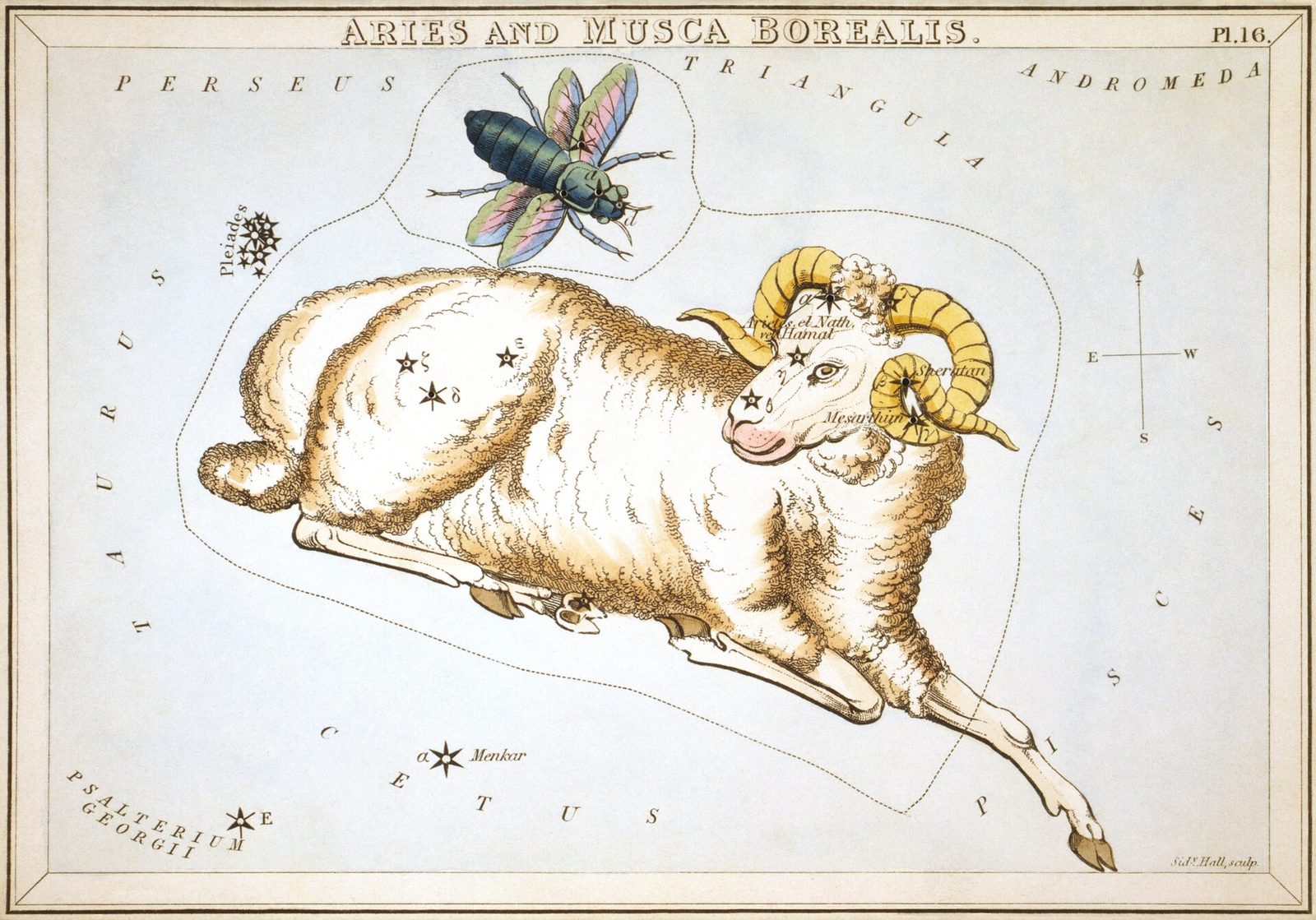
Introduction
Aries is the first sign of the tropical zodiac, occupying the stretch of the ecliptic that begins at the March equinox in Western astrology. That calendrical placement is one reason later writers connected the sign with openings, first moves, and the visible return of longer days in the Northern Hemisphere. Zodiac Quill treats those associations as part of a long interpretive tradition rather than as a personality test with a single correct score.
People born while the Sun is said to be in Aries are often described, in popular astrology, as direct and restless. Traditional texts are more mixed: they discuss planetary rulership, seasonal qualities, and mythic images of the ram. This page gathers those layers—symbol, history, and commonly repeated traits—so readers can see how the sign is talked about, not so they can be told who they must be.
Symbol
The traditional emblem is the ram. Glyph: .
The ram is the most familiar Aries image in European star atlases. Its curved horns are easy to stylize, which helped the figure survive on coins, manuscripts, and nineteenth-century teaching cards such as Sidney Hall’s Urania’s Mirror. In myth retellings used by later astrologers, the ram is sometimes linked to the Golden Fleece story, though the constellation’s older Mesopotamian identity was not that Greek tale.
Fire, in the four-element scheme inherited from Hellenistic astrology, is associated with dryness, heat, visibility, and swift change. Cardinal modality is associated with initiating a season. Combined, Aries is often described as a spark: useful for starting work, less often praised for lingering. Those metaphors are literary tools. They do not measure a person’s character.
Historical background
In Babylonian celestial omens, the corresponding portion of the sky was associated with a hired laborer (often given as LU.HUN.GA), a figure tied to the agricultural year rather than to a ram. Greek and later Hellenistic astrology re-mapped the ecliptic into twelve signs of thirty degrees each and aligned Aries with the vernal point used in their tropical framework.
Medieval Latin handbooks repeated Mars as the sign’s domicile ruler and discussed Aries in medical and electional contexts (choosing times for actions). Renaissance printers popularized ram illustrations that still shape how the sign looks online. Modern sun-sign columns simplified all of that into a few adjectives. This site keeps the older seasonal and symbolic material in view so the simplified version is not mistaken for the whole tradition.
Commonly associated traits
Astrology columns often associate Aries with speed, competitiveness, and a dislike of waiting. Hellenistic and medieval writers instead emphasize Mars: cutting, separating, heating, and stirring. Those planetary metaphors were applied to weather, bodies, and civic events as well as to people.
When contemporary writers say people born under Aries are “bold,” they are repeating a sun-sign shorthand. A full natal chart, in the same tradition, would also weigh the Moon, the rising sign, and planetary conditions. Even then, astrology remains an interpretive craft, not a validated psychological instrument.
Strengths
In traditional language, Aries is credited with initiative, physical courage, and a willingness to go first. Teachers of modern astrology often suggest Aries symbolism as a prompt for noticing where a person starts projects or defends a boundary. Used that way, the sign is a vocabulary for self-reflection, not a medal.
Challenges
The same literature warns that Martian heat can look like impatience, interruption, or a habit of treating every delay as a contest. Those “challenges” are stock motifs. They are not diagnoses. If a description feels useful, it is because it names a pattern you already recognize—not because a calendar date proved it.
Love and relationships
Relationship writing about Aries often stresses honesty, pace, and the need for room to act. Compatibility lists that rank Aries with other fire signs are a twentieth-century popular format. Older astrology discussed synastry through planetary aspects and house overlays. Neither method is a scientifically established predictor of partnership outcomes.
Friendship
Friendship portraits of Aries tend to praise loyalty expressed as showing up quickly, and they caution against heat in argument. Treat those sketches as character tropes from a shared symbolic language.
Work and interests
Vocational astrology sometimes links Aries imagery to roles that require a first decision: emergency response, entrepreneurship, advocacy, sport. Historical electional astrology used Mars and Aries for beginnings of campaigns or surgeries in medical astrology—practices that should not be confused with modern professional advice.
Compatibility overview
Popular lists often pair Aries with Leo and Sagittarius (fellow fire signs) and with Gemini or Aquarius (air signs). Traditional authors would look at Venus, Mars, the Moon, and the condition of the seventh house before making a relationship judgment. Interpretations vary widely, and no pairing is guaranteed.
Astrology compatibility is a cultural interpretation rather than a scientifically validated method of predicting relationship outcomes. See also Compatibility.
Related zodiac signs
Pisces
A mutable water sign shown as two fish, traditionally Jupiter-ruled, with Neptune added in many modern lists, closing the tropical year.
Learn moreTaurus
A fixed earth sign linked to the bull, seasonal stability after the spring equinox, and Venus as its traditional domicile ruler.
Learn moreLeo
A fixed fire sign figured as a lion, traditionally ruled by the Sun, and associated with midsummer visibility in the tropical year.
Learn moreSagittarius
A mutable fire sign pictured as a centaur archer, traditionally ruled by Jupiter and associated with aim, travel, and teaching metaphors.
Learn moreRelated guides
Guide
What Is a Zodiac Sign?
A zodiac sign is a named slice of the ecliptic used in natal diagrams. This guide separates signs from constellations, dates from myths, and magazine adjectives from older teaching.
Read essayGuide
The Four Elements in Astrology
The four elements sort the twelve signs into fire, earth, air, and water. This guide explains the scheme, triplicity ideas, and how to use the language without treating it as a lab result.
Read essayGuide
Mars in Astrology
Mars in the astrological tradition names a toolkit of separation, courage metaphors, and drive. This guide explains rulership, aspects, and why Mars is not a measure of aggression.
Read essayGuide
Cardinal, Fixed and Mutable Signs
Each zodiac sign also has a modality: cardinal, fixed, or mutable. This guide explains the seasonal idea, the three crosses, and how to read the terms without turning them into job reviews.
Read essayFrequently asked questions
When is Aries season in tropical astrology?
In the tropical zodiac used by most English-language horoscopes, Aries is associated with about March 21 to April 19. Exact boundaries depend on the year and on whether a writer uses the Sun’s ingress to the nearest minute.
Is Aries the same as the constellation Aries?
No. The tropical sign is a thirty-degree sector of the ecliptic tied to the seasons. The constellation is an irregular star pattern. Precession has shifted their alignment over centuries.
Why is Mars the traditional ruler?
Hellenistic astrology assigned Mars as the domicile ruler of Aries. Modern writers sometimes add a co-ruler discussion, but Mars remains the standard traditional assignment.
Does being an Aries determine personality?
Sun-sign labels are a cultural shorthand. They are not a complete chart and not a scientific personality assessment.