♊ Tropical sign
Gemini
A mutable air sign figured as twins, traditionally ruled by Mercury and associated with language, exchange, and dual figures in the sky.
Introduction
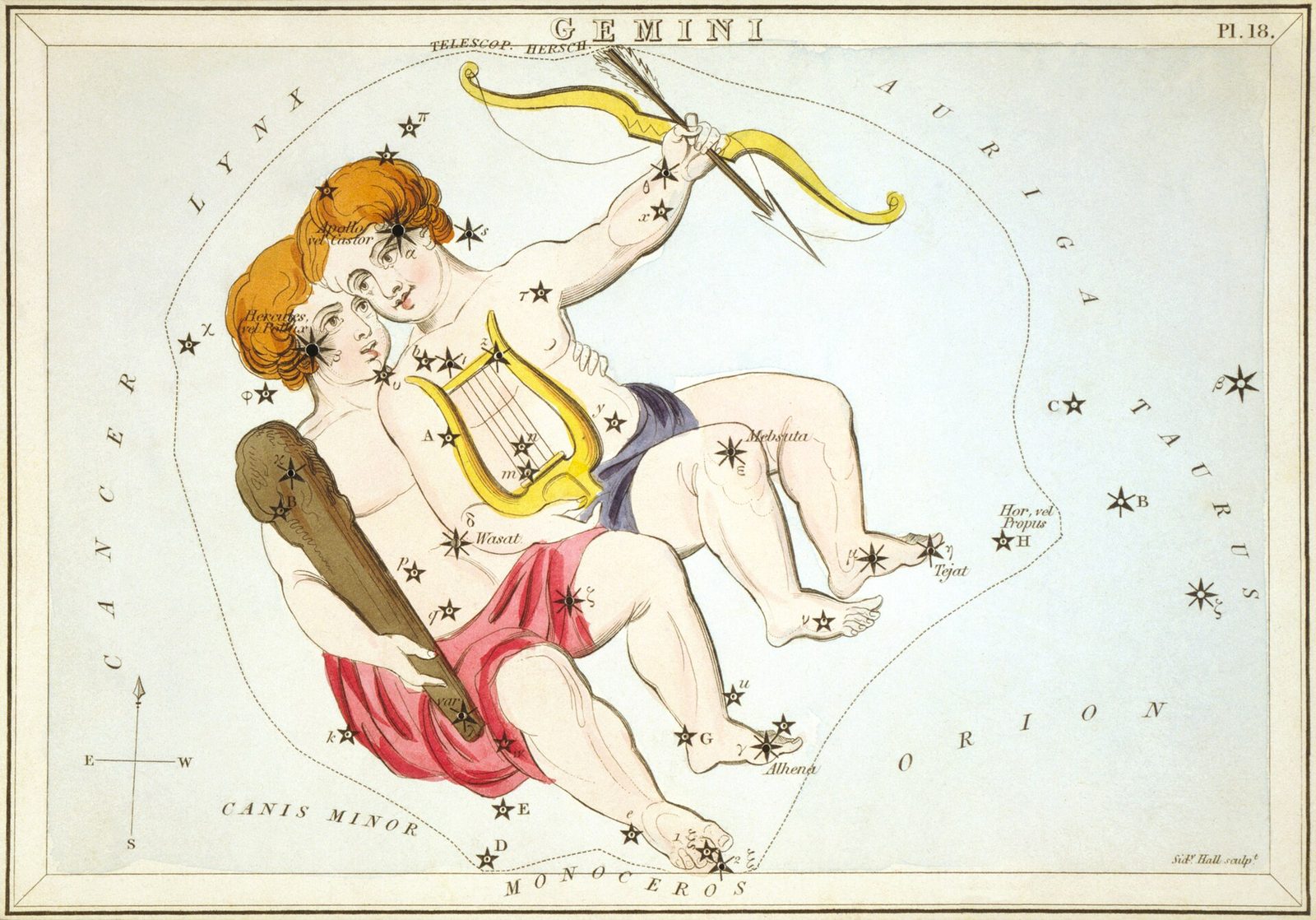
Gemini is the third tropical sign, arriving as late spring leans toward the Northern summer. Its emblem is a pair: two figures, two names, two directions of a conversation. In star lore the pair is often Castor and Pollux, the Dioscuri, though the sign as used in horoscopes is a seasonal sector, not a photograph of those stars.
Because Mercury is the traditional ruler, Gemini collected associations with speech, trade, letters, and clever movement between places. This page keeps those ideas in their literary setting. Duality here is a symbol, not a claim that people born in June have “two personalities.”
Symbol
The traditional emblem is the twins. Glyph: .
Twins suggest mirroring and difference at once. Air, in elemental astrology, is linked to what circulates: wind, rumor, breath, ideas. Mutable modality is associated with transition between seasons. Together, Gemini is often pictured as a hinge—useful for translation, teaching, and short journeys in traditional house and sign lore.
The visual history of the sign includes two standing youths, sometimes with musical or martial attributes, a reminder that the Dioscuri were patrons of sailors and horsemen as well as of sibling affection.
Historical background
Mesopotamian astronomy recognized a twin or pair figure in this region; Greek mythology supplied Castor and Pollux. Hellenistic astrology placed Mercury in domicile in Gemini (and also in Virgo, with a more complex exaltation scheme). Medieval encyclopedias listed Gemini among signs related to letters and messengers.
Print-era constellation cards made the twins a classroom image. Twentieth-century columns turned Mercury’s quickness into “chatty,” a thinner story than the older mix of commerce, craft, and celestial twin myths.
Commonly associated traits
Sun-sign writing often calls Gemini curious, verbal, and changeable. Traditional Mercury words include interpreting, calculating, and mediating. Those are occupational and cosmological metaphors. They should not be used to excuse unreliability or to flattered talkativeness as destiny.
Strengths
Reflective uses of Gemini symbolism include facility with language, pattern-spotting, and the ability to hold two accounts of an event long enough to compare them.
Challenges
Stock cautions mention scattered attention, talking past the point, or treating every topic as a debate to win. Those are essayistic tropes about air and mutability.
Love and relationships
Popular compatibility copy likes Gemini with Libra and Aquarius, or with Aries and Leo. It often emphasizes conversation as courtship. Traditional synastry would still start with Venus, the Moon, and angular houses. No method here predicts a relationship’s future.
Friendship
Friendship portraits highlight wit and news. They also recycle a warning that the Gemini-stereotyped friend may vanish into a new interest. That is folklore about attention, not evidence.
Work and interests
Mercury’s catalog of work—scribes, merchants, translators, teachers, journalists—got attached to Gemini in later vocational astrology. Historical medical astrology also connected Mercury with hands and speech, which is of antiquarian interest only and not medical advice.
Compatibility overview
Air–fire pairings are often called stimulating; air–earth pairings are often called effortful in element cookbooks. Treat those sentences as style notes from a tradition. Compatibility interpretations vary.
Astrology compatibility is a cultural interpretation rather than a scientifically validated method of predicting relationship outcomes. See also Compatibility.
Related zodiac signs
Taurus
A fixed earth sign linked to the bull, seasonal stability after the spring equinox, and Venus as its traditional domicile ruler.
Learn moreCancer
A cardinal water sign linked to the Moon, the Northern summer solstice in tropical astrology, and crab or crayfish imagery on historical star maps.
Learn moreLibra
A cardinal air sign whose symbol is a pair of scales, tied to the September equinox and to Venus as a traditional ruler.
Learn moreAquarius
A fixed air sign shown as a figure pouring water, traditionally Saturn-ruled, with Uranus added in many modern planetary schemes.
Learn moreRelated guides
Guide
Mercury in Astrology
Mercury is the traditional ruler of Gemini and Virgo and a fast messenger in natal diagrams. This guide covers domicile ideas, retrogrades as apparent motion, and cautious keywords.
Read essayGuide
Sun Sign vs Moon Sign
The Sun sign is the familiar magazine label. The Moon sign tracks a faster cycle and often needs a birth time. This guide explains how traditional and modern writers treat the pair.
Read essayGuide
What Is a Zodiac Sign?
A zodiac sign is a named slice of the ecliptic used in natal diagrams. This guide separates signs from constellations, dates from myths, and magazine adjectives from older teaching.
Read essayGuide
What Are Planetary Aspects?
Planetary aspects describe how planets “see” one another by angle. This guide covers the major Ptolemaic aspects, orbs, and why a square is a metaphor, not a diagnosis.
Read essayFrequently asked questions
Are Gemini and the constellation the same?
The sign is a tropical thirty-degree span. The constellation Gemini is a different, irregular sky region. They share a name and a history, not identical boundaries.
Why twins?
Greek star lore identified two figures, often Castor and Pollux. The sign inherited that image.
Does Mercury rule Gemini?
Yes, in the traditional domicile scheme. Mercury also has a primary role in Virgo.
Is Gemini “two-faced”?
That insult is a modern distortion of twin symbolism. Duality in the image is mythic, not a moral judgment about people.